
How the FGM Caravan brought Tanzania’s National Plan to Communities.

Updated: 1 day ago
Ending Female Genital Mutilation (FGM) requires more than laws, policies and national commitments. It requires communities to understand the harm, question the social norms that sustain the practice and, most importantly, see themselves as part of the solution. It is within families, villages, faith communities and local institutions that decisions affecting girls are made, and it is in these same spaces that lasting change must take root.

Recognising this, the Government of Tanzania, through the Ministry responsible for community development, with support from UNFPA, the Government of Finland and the Embassy of Ireland, in collaboration with C-Sema, Hope for Girls and other partners, took the Multisectoral Plan to End Female Genital Mutilation beyond policy spaces and into the communities it is designed to serve. Through the FGM Caravan, stakeholders travelled across Dodoma, Arusha, Manyara, Singida and Mara, creating spaces for communities to learn about the Plan, reflect on the realities of FGM in their own contexts and identify what they can do to accelerate its elimination.

The Caravan was therefore not simply a dissemination exercise. It was an opportunity to translate a national framework into local conversations and, in doing so, strengthen the ownership that will be essential to achieving sustainable change. Across the five regions, the discussions brought together about 2000 women, men, children, young people, religious leaders, traditional leaders, educators and other community actors. Their perspectives were different, but the common question was: what will it take for communities to move from knowing that FGM is harmful to intentionally choosing to end it?

At the launch at Machinga Complex in Dodoma, participants emphasised that communities need to understand not only that FGM is harmful, but why it is harmful, what the law says, where support is available and what role each person can play in protecting girls.
This emphasis on knowledge and ownership shaped the conversations that followed as the Caravan moved into the regions.
In Chemba, Dodoma, participants reflected on the importance of engaging women in efforts to end harmful practices. Women can be influential in decisions affecting girls, particularly within families and communities, making their participation essential to changing practices that have been passed from one generation to another. A traditional medicine practitioner proposed that FGM should become a regular subject in town hall meetings so that communities have continued opportunities to discuss the issue rather than treating it as a once-off campaign. The discussion also created space to acknowledge violence affecting men, reinforcing the importance of community dialogues that allow people to speak about the broader social norms and experiences shaping their lives.
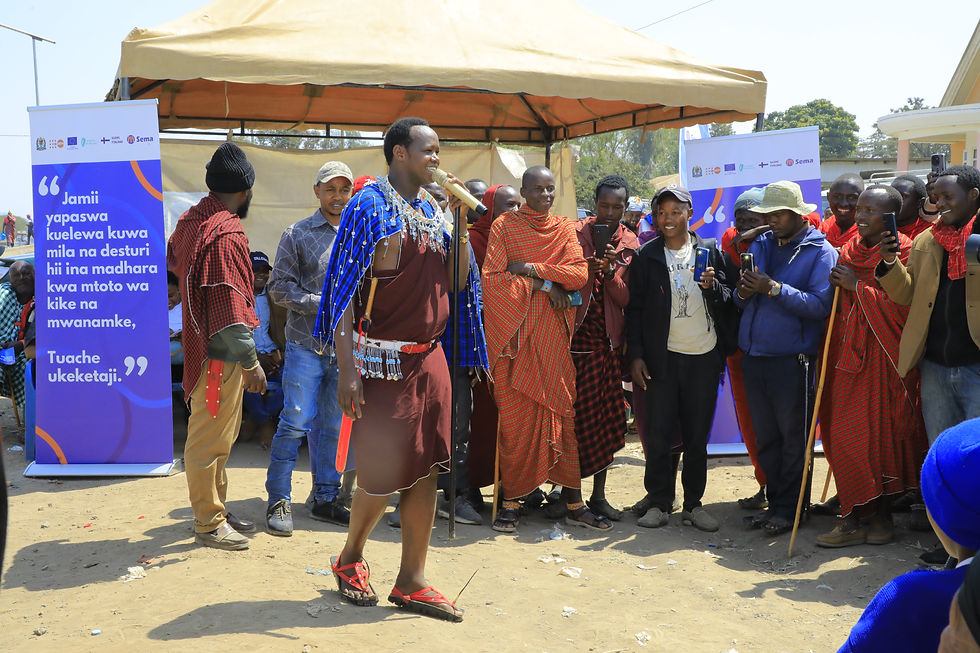
As the Caravan reached Meserani in Monduli, Arusha, the conversation demonstrated why engaging trusted community voices is so important. A Sheikh reminded participants that girls have inherent value and that religious teachings recognise this value. When practices cause harm to girls, he argued, that value is undermined. Religious leaders, he added, have a responsibility to take this knowledge beyond community dialogues and into their regular gatherings, where they can help communities reflect on beliefs and practices that affect girls.
The conversation became even more personal when women who had experienced FGM themselves chose to speak.
One woman introduced herself simply: “I am a woman and I am Maasai. I was cut, and now I am an advocate against this issue because it has way more harm than good.”
Another woman shared the psychological and physical consequences she experienced after being cut as a child. She spoke of the emotional pain that affected her confidence and relationships, and of a difficult childbirth during which she experienced heavy bleeding and nearly lost hope. When she later asked her mother why she had allowed her to undergo FGM, her mother explained that she had believed it would help her remain in her marriage. Her intentions, the woman reflected, were not bad; she simply did not know better.
Her story captures an important part of the challenge the Caravan sought to address. Ending FGM requires communities to confront harmful practices while also understanding the beliefs, fears and social expectations that have allowed them to continue. It means creating opportunities for families to access accurate information and make different choices for the next generation.
Men were also encouraged to recognise the role they can play in that change. During the Meserani dialogue, one father pointed to his daughter and made a personal commitment:

“If we men say no to FGM, that will be a stride. My daughter is here and I promise to protect her.”
Another community member and educator spoke about the collective responsibility to stop FGM, highlighting the health consequences women can experience, including complications during childbirth. Lilian from VOYOTA further broadened the conversation by drawing attention to the mental health consequences of FGM, including impacts on confidence and increased isolation effects that may remain invisible even when the physical wounds have healed.
For young people, the responsibility was equally clear.
“FGM involves everyone in the community. We all have a role to play,” one participant said.
When the discussion turned to what communities can do when they encounter FGM or a girl at risk, participants identified reporting mechanisms including the 116 Child Helpline, reinforcing the importance of accessible channels through which children and communities can seek help and raise concerns.
In Manyara, the Caravan encountered another layer of the challenge: how early FGM can occur. During discussions in Mbulu, Masqaroda Ward, participants shared that girls can be subjected to FGM from as young as three years old and, in some cases, even as babies. This makes community awareness and early prevention particularly important because children subjected to the practice at such a young age may have little ability to understand what is happening to them or speak out.
Participants called for communities to challenge myths surrounding FGM and for women and men to continue educating one another. There were also calls for wards and villages to establish committees that can follow up on FGM incidents, support community education and help ensure that existing laws are followed. Participants recognised that those who perform the practice, including ngaribas, also need to be reached with information and encouraged to abandon it.
At Haydarer Ward, the message from women was equally powerful. One woman reflected on her own experience and said,
“It’s not okay to cut girls. We were already cut, but I would not want us to continue doing this to our daughters.”

She urged children and girls to speak up when they are at risk and reminded the community that FGM is a crime. A child then offered a commitment that perhaps best illustrates what community-level change can look like:
“I’ll go home and tell my mother that FGM is not allowed and we shouldn’t practise it.”
The conversation had moved beyond the meeting itself; the knowledge was going home with the people who had heard it.
In Singida, women once again took a strong position in the dialogue. One participant challenged the belief that FGM had disappeared from the community, explaining that girls may still be cut when they are very young, including as babies. Another woman drew a firm boundary around the future she wanted for her children:
“My girls won’t be cut, and if it means marrying outside of my clan, so be it.”
Her statement highlighted the social pressures that can make abandoning FGM difficult, particularly where the practice is connected to ideas about marriage, clan and belonging. Participants also called for stronger attention to prevention within health facilities, including suggestions that children attending hospitals could be checked for signs of FGM.
By the time the Caravan reached Mara, the conversations had become an even more direct examination of the relationship between culture and change. In Serengeti and Tarime, participants acknowledged that FGM remains deeply connected to cultural expectations. A traditional leader reminded community members that FGM is against human rights and encouraged them to participate fully in the dialogue, while others openly questioned why their particular cultural practices were receiving attention. These tensions are important because they show that ending FGM is not simply a matter of communicating that the practice is harmful. It also requires communities to examine the social meaning attached to it and to identify ways of preserving positive aspects of cultural identity without perpetuating harm.

Amid these difficult conversations, community members also articulated alternative futures. One woman urged families to prioritise girls' education instead of cutting or marrying them off, sharing that she and her husband were advocates for this approach. At Musati, an elder and father spoke openly in front of his peers about his desire to see FGM end.
“It’s part of tradition, but not all traditions are beneficial,” he said, acknowledging both the cultural significance of the practice and the need to question traditions that harm girls.
Another father, who has only sons, said he would support his sons if they chose to marry women who had not undergone FGM. Yet another participant expressed how deeply social expectations remain embedded, saying, “I can’t marry an uncut woman. How will I give her cows?”

The exchange captured the complexity of the work ahead: FGM is intertwined with expectations around marriage, family, culture and social belonging. Sustainable change therefore requires communities to address not only the act itself, but also the norms that give it meaning.
Across the five regions, the Caravan demonstrated the value of taking national commitments to the places where they must ultimately be implemented. The Multisectoral Plan to End FGM provides a shared national direction, while the leadership of the Government of Tanzania and the support of partners including UNFPA, the Government of Finland and IrishAid help create the space, resources and partnerships needed to move that commitment forward.

What emerged from the Caravan was not one single message, but a growing collection of commitments. A father promising to protect his daughter. A woman deciding that her daughters would not experience what she had experienced. A child planning to take the message home. A religious leader committing to use his platform. An elder questioning whether every tradition should be preserved. And communities beginning to consider how they can organise themselves to prevent, report and respond to FGM.
These voices are important because national plans become meaningful when communities can see their own role within them. Ending FGM will require laws and enforcement, but it will also require knowledge, dialogue, trusted leadership, reporting mechanisms and sustained community ownership.

The Caravan may have travelled through five regions, but the work it represents must continue long after the vehicles leave.
The real measure of success will be what happens next: when the conversations continue in homes, schools, mosques and churches; when town hall meetings keep FGM on the agenda; when men and women speak together about protecting girls; when communities report cases; and when children grow up knowing that their bodies, futures and rights are worth protecting.
The journey across Dodoma, Arusha, Manyara, Singida and Mara was a reminder that ending FGM is not the responsibility of one institution, one sector or one community. It is a collective commitment and every conversation that moves a community closer to saying “no” is a step towards a Tanzania where every girl can grow, learn and thrive free from FGM.
Prepared by C-Sema's Communication Team.


